Eye-tracking
Solutions
Overview
JIIOV's eye-tracking solutions use gaze-estimation algorithms powered by its perceptual interaction foundation model. They operate independently of specific hardware configurations on smart devices.Traditional pupil center corneal reflection (PCCR) systems rely on precisely calibrated hardware and specific light-source arrangements, limiting design flexibility for compact devices. JIIOV's hardware-agnostic approach delivers high-accuracy eye tracking at high frame rates, maintaining reliable performance in challenging conditions such as bright outdoor light, lens reflections, and user movement.The technology generalizes well across applications and can be readily adapted beyond smart glasses to embodied robotics and other emerging uses.
Technical Specifications
JVE403 Eye-tracking Camera Module
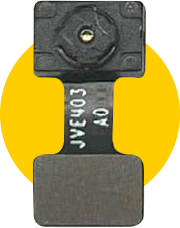
Supports dynamic high resolution, dynamic frame rates, and dynamic power consumption; supports national standard payment-level iris recognition; features a 3P HD adjustable-focus lens with an 82° wide field of view (FOV), compact size; uses SPI interface, which does not occupy MIPI interface, reducing chip platform selection requirements.
- - Module size: 5.29x3.6x2.62mm
- - FOV: 85°
- - Resolution: 168*168~504*504
- - Output interface: SPI
- - Frame rate: 24fps~100fps
JIIOV Eye Tracking Algorithm
Low hardware threshold

- Low camera resolution requirements: High-precision eye-tracking can be achieved even with low-resolution cameras.
- Monocular single-camera recognition: Visible light eye-tracking is possible with just one camera and one lens, no LED light needed for supplementary illumination.
Massive Data Driven

- Feature learning: No manual feature design is needed. Model optimization relies on training, significantly improving recognition accuracy, especially in complex environmental images.
- Continuous optimization: Accuracy continues to improve with the accumulation of data and the enhancement of the learning model.
End-to-End Visual Large Model

- Simplified process: The end-to-end system does not require manual design or optimization of multiple sub-modules, significantly reducing development complexity.
- Global optimization: The system efficiently captures global data characteristics, providing optimal performance.
Strong Robustness

- Outstanding anti-interference ability: Adapts to various complex scenarios such as outdoor strong light, intricate reflection points, overexposure, or insufficient lighting. It maintains recognition even during motion and jitter, ensuring accuracy even in cases like glasses slipping or near-sighted lenses below 700°.
- Stable eye-tracking accuracy: The accuracy remains consistent regardless of environmental or external changes.
Features

Eye-Tracking Gaze Coordinate Calculation
- Application scenarios: Eye (hand-eye) interaction, gaze point rendering, attention analysis, eye movement heatmap analysis.

Adaptive Eye-Tracking Precision with Eyewear Slippage
- Supports adaptive adjustment of eye-tracking precision when glasses slip up or down within 3cm, ensuring no significant loss in accuracy.

Iris Recognition
- Application scenarios: Identity authentication, iris-based payments.

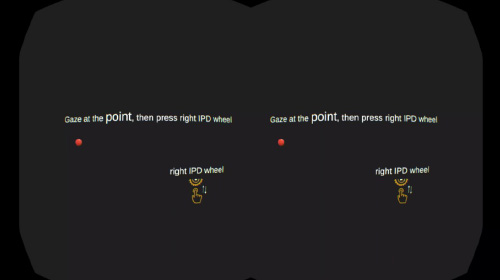
Automatic Pupil Distance Adjustment
- Feature: Supports non-calibration pupil distance adjustment, with binocular error less than 1.2mm.

Real-Time Pupil Size Detection
- Feature: Real-time detection of pupil size, with an error of less than or equal to 1mm.
- Application scenarios: Emotion analysis, attention analysis.

Real-World Eye-Tracking Calibration, Automatic Algorithm Verification
- Even in non-display AI glasses scenarios, real-world eye-tracking calibration can still be achieved.
- If calibration errors occur, the system can prompt for re-calibration without requiring the user to look at a calibration target.

Binocular Gaze Focus Distance Estimation
- Feature: Provides gaze point distance data within a 0-3 meter range, with an error of 10cm.
- Application scenarios: Automatic focus function for high-end VR devices to reduce dizziness, myopia prevention.

Virtual Avatar Support
- Recognizes the open/closed state of both eyes and pupil positioning.
- Recognizes the degree of eye opening/closing, with precision less than 1°.
Application Cases
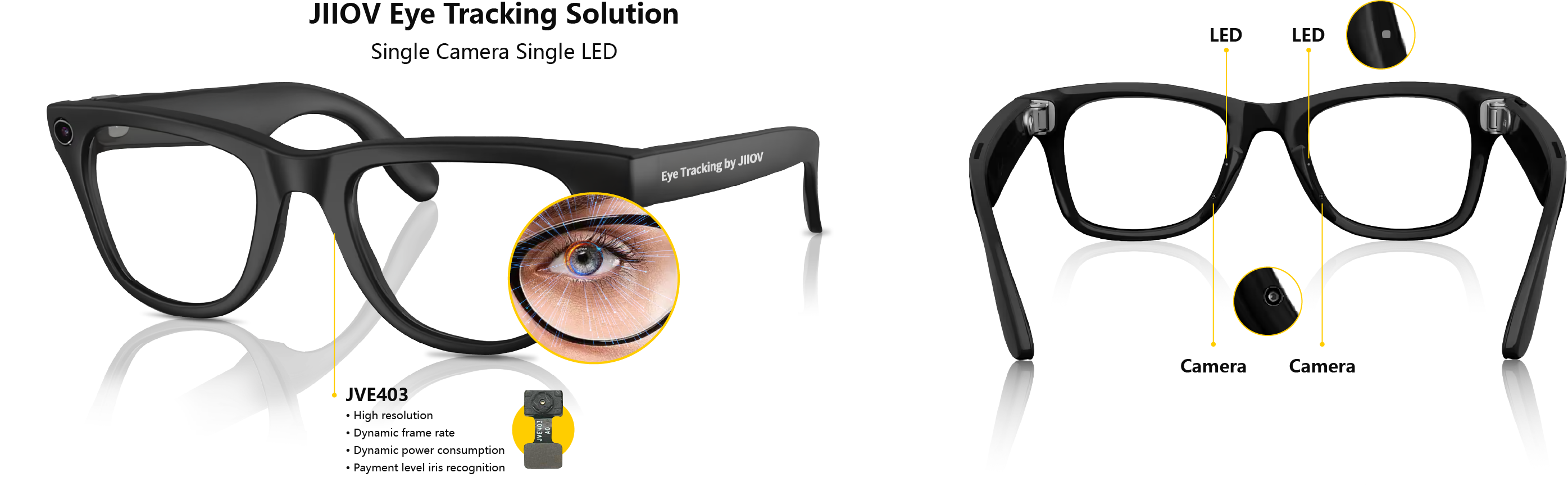
JIIOV Technology AI Glasses Eye Tracking Solution
The hardware uses JIIOV's dedicated eye tracking module JVE403 to obtain eye images and calculate the user's line of sight through the eye tracking algorithm. The algorithm interface output fully complies with the OpenXR standard.
Technical Specifications
Take JVE403 integrated hardware and software solution as an example
| Specification | JVE403 |
|---|---|
| Eye movement recognition accuracy | Average accuracy within eye movement range <0.5° |
| Iris Recognition FRR | >99% |
| Iris recognition FAR | 1/1,000,000 |
| Algorithm output frame rate FPS | 10~240 |
| IPD adjustment accuracy | +-1.2mm |
| Functional support | Eye tracking, iris recognition, IPD pupil distance adjustment, annotation point rendering, binocular line of sight estimation, outdoor strong light anti-interference |
| Real-time pupil size detection accuracy | +-1mm |
| Strong light detection, algorithm adjusts exposure time | Reduce exposure time to 0.1ms |
| Binocular line of sight focal length estimation accuracy | +-5cm |
| Calculation of eye movement coordinates | Support real-time output |
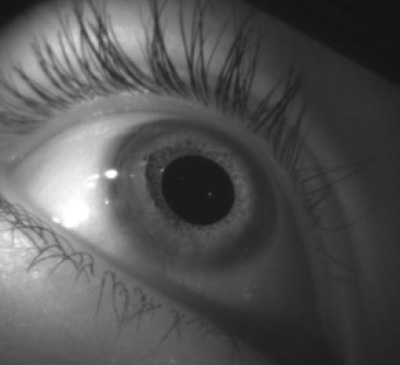
JIIOV JVE403
Shooting angle <30° External eye iris effect
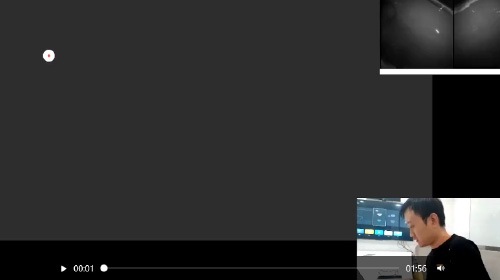
Solution Function Demonstration
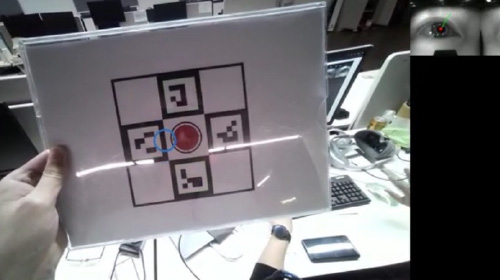
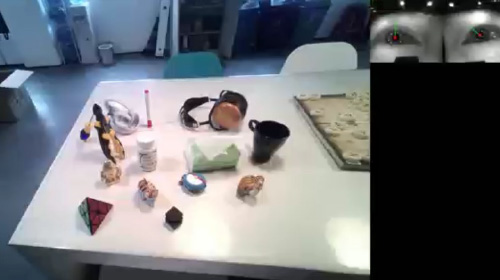
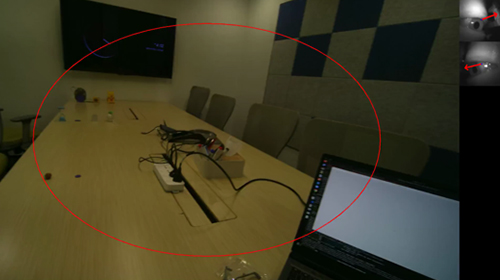
Accuracy and Precision Demo in Real-World Scenarios
Eye-tracking performance remains stable even under strong outdoor lighting.